Cetaceans
Whales, Dolphins, and Porpoises
- Cetaceans are named after Cetus, a sea monster in Greek mythology both Perseus and Heracles needed to slay
- Cetus is also a constellation in the sky
- Examples: blue whale, humpback whale, killer whale (orca), beluga whale, dolphins
- Cetaceans are the largest group of marine mammals
- Largest group of marine mammals
- Spend entire lives in the water
- There are 90 different species of Cetaceans
- 85 are marine
- 5 are freshwater dolphins
- Whales and dolphins are not fish
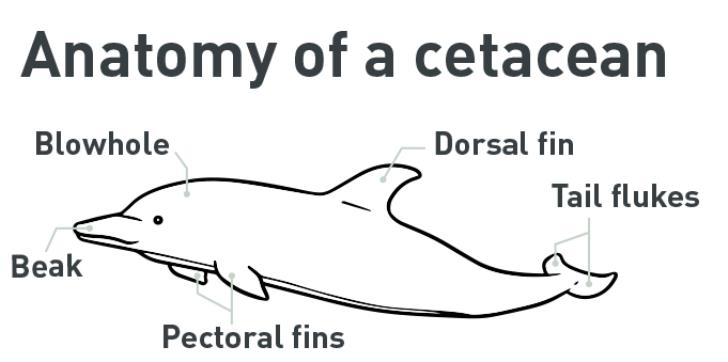
- Anatomy of a cetacean
- Shape
- Streamlined
- Fins
- Pectoral fins (Flippers) used for steering
- Most have a dorsal fin
- Blowholes (for respiration)
- Cetaceans have a blowhole (single or double) on the top of their heads
- Function as nostrils
- inhale and exhale air ONLY through their blowholes
- They do not blow water out of their blowholes
- **CETACEANS CANNOT BREATHE THROUGH THEIR MOUTHS**
- The blowhole is connected to the trachea
- The mouth does not
- This prevents food from going into the cetaceans’ lungs
- Nasal Plug
- Prevents water from getting into the blowhole
- Contracts when diving underwater
- Opens when surfacing
- Fluke (Tail)
- Separated into lobes
- Separated by a notch
- Made of cartilage
- Propels animal forward by moving up and down
- Flukes differ from species to species
- In some species, flukes are so unique researchers can use them like fingerprints to ID individuals.
- Diving
- While diving, cetaceans reduce their oxygen use by lowering their heart activity and blood circulation
- Individual organs receive no oxygen during this time.
- Some average dive times:
- Dolphins: 8-10 mins
- Sperm whales: 60-90 mins
- Bottlenose whales: 2 hours
- Sleeping
- Cetaceans practice unihemispheric slow-wave sleep (USWS)
- This means they sleep with one side of their brain at a time
- They can still breathe and swim to avoid predators
- Toothed vs. Non-Toothed Whales
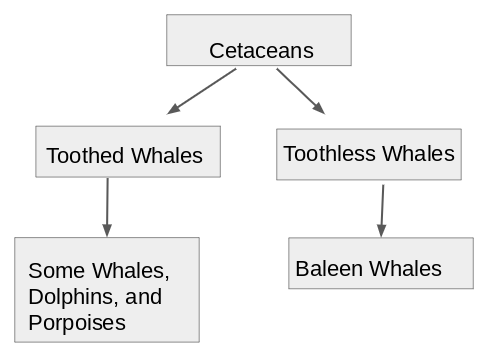
- Toothed whales
- Have teeth
- Have one blowhole
- Generally smaller than Baleen whales
- Predators: find, chase, capture prey
- swallow prey whole
- Use echolocation
- Examples of toothed whales: Orca, Beluga, Pilot Whale, Sperm Whale, Narwhal
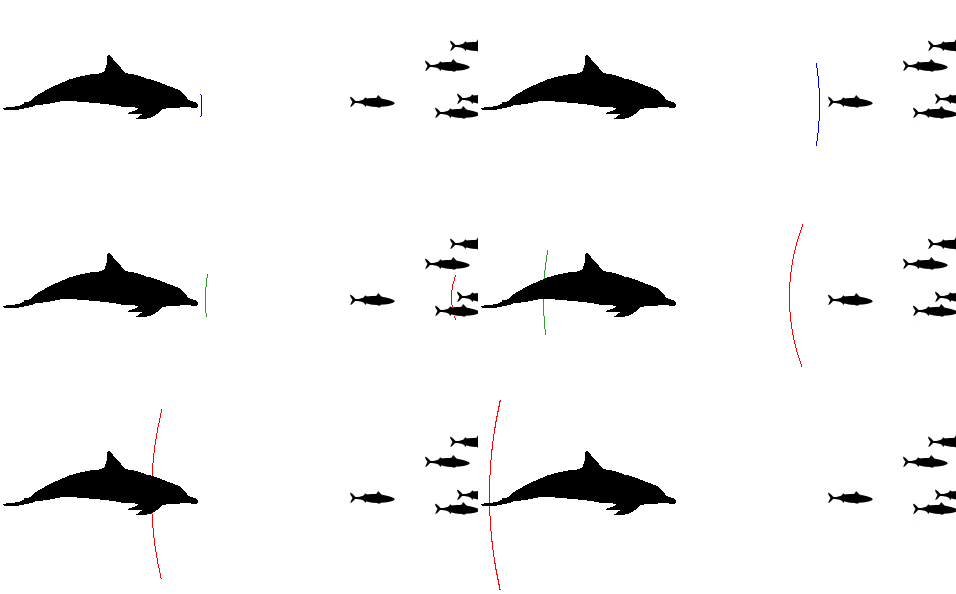
- Echolocation
- Works as a navigation system and can detect objects in the water.
- Sends out signals called “Ultrasounds” from their nasal passage
- How it works: Signal bounces off objects and returns to give a clean “Sound-picture” of the object's size, shape and location

- Melon
- A mass of fat/wax found in the forehead of toothed whales.
- Acts as an acoustic lens for echolocation and communication
- Different size/shape in all species
- Non-Toothed Whales
- Have series of baleen (whalebone) plates in gums along each side of upper jaw
- Baleen feeding behavior
- Eat plankton or small schooling fish like krill
- Use baleen to strain food from water
- Two blowholes
- Travel alone or in small groups
- Biggest: Blue Whale (90 ft)
- Smallest: Pygmy right whale (15-20 ft)
- Whales sing
- Examples: Minke whale. blue whale, humpback whale,
- Dolphins vs. Porpoises
Characteristic |
Dolphin |
Porpoise |
Beak |
Pointed snout |
Blunt snout |
Dorsal Fin |
Wave shaped |
Triangular |
Teeth |
Pointed and cone-shaped |
Flat with upper edges that are circular and sharp |
Size |
Up to 12 feet |
Up to 7 feet |
Lifespan |
40-60 years |
8-10 years |
Melon |
Present |
Absent |
Groups |
Large pods of 12+ |
Small groups of ~4 |
Human Relations |
Friendly to |
Shy of (hide) |